
Professional Carpet Cleaning
in Lansing, MI
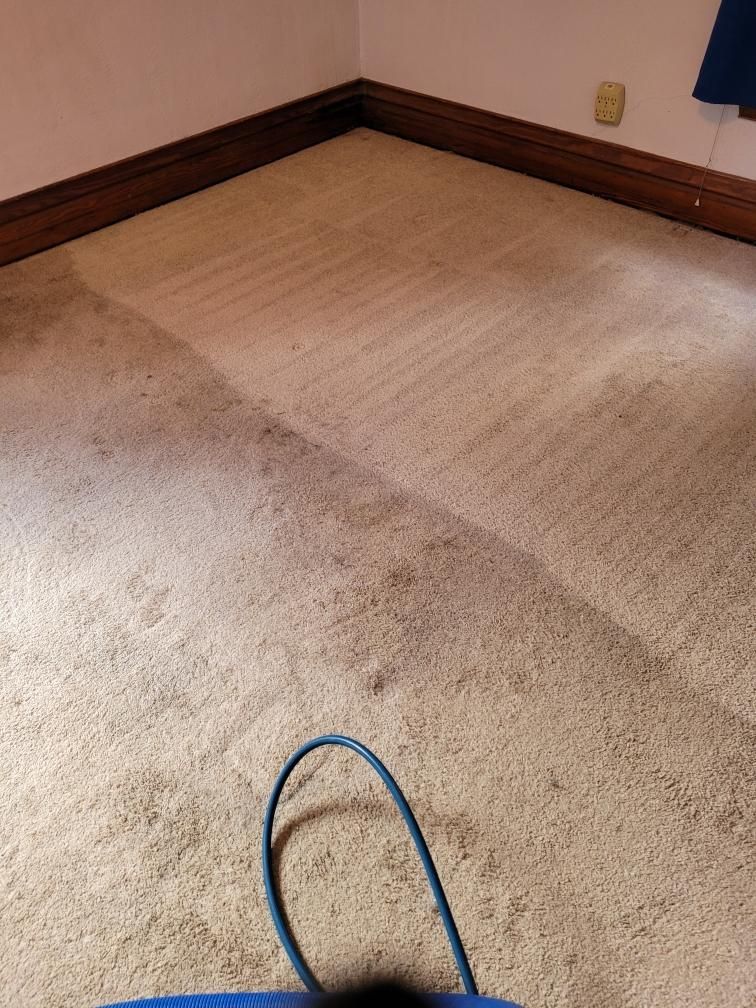
What Michigan's Climate Does to Your Carpet
Michigan winters mean four to six months of road salt being tracked indoors. Salt is hygroscopic — it attracts and holds moisture — and mildly acidic.
Over repeated exposure cycles, salt degrades the protective coatings that carpet manufacturers apply to fiber surfaces, making fibers more susceptible to staining and soil adhesion.
Salt crystals are abrasive: under foot traffic, they grind against carpet fibers at the base of the pile, cutting filaments and accelerating the matted, worn appearance that develops in high-traffic Michigan entryways faster than in comparable carpets in warmer, salt-free climates.
Spring mud season in Michigan — typically March through May — brings a distinctive heavy soil load. Michigan's soil in the greater Lansing area is clay-loam with a high fine-clay content.
This fine clay settles deep into carpet pile and binds to fiber in a way that coarse sandy soil does not. It is the reason that a Michigan entryway carpet that "just looks a little dirty" may have a substantial embedded soil load that is degrading the fiber below the visible surface.
Michigan's summer humidity — averaging 60 to 80 percent relative humidity — creates moisture vulnerability in carpet pad in areas with poor air circulation.
Carpet can appear dry and clean at the surface while the pad beneath retains moisture from humidity accumulation or a past water event. This creates conditions for mold and mildew in the pad that become apparent only when the moisture load is sufficient to produce odor or visible growth at the surface.
Practical takeaway: Michigan homes and businesses benefit most from professional carpet cleaning in early spring, after salt season ends, and again in late fall before tracking season begins.
For high-traffic entryways and hallways, twice-yearly professional cleaning is often appropriate. Call
(517) 582-1083 to discuss a schedule that matches your home's actual cleaning needs.

Why Hot Water Extraction Beats Every Other Carpet Cleaning Method
Hot water extraction is the method recommended by every major carpet manufacturer — Shaw, Mohawk, Karastan.. The mechanism is straightforward: hot water and cleaning solution are injected into the carpet pile under pressure, loosening and suspending soil particles, then immediately extracted by powerful vacuum. The soil leaves the carpet. That is the critical distinction.
Bonnet Cleaning
Bonnet cleaning uses a rotating absorbent pad pressed against the carpet surface. It picks up surface soil onto the pad but pushes deeper soil laterally through the pile.
It is a surface-only method — it makes carpet look cleaner temporarily but does not address the embedded soil in the lower pile and backing. It is common as a quick commercial maintenance step between deep cleans.
It is not a substitute for hot water extraction in residential or commercial deep-clean applications.
Dry Compound
Dry compound cleaning distributes an absorbent powder through the carpet that is supposed to encapsulate soil particles, which are then vacuumed up.
There is no flushing, no heat, and no extraction of deeply embedded particles. It addresses surface-level soil adequately and dries immediately, which is its appeal for light commercial maintenance.
It cannot address allergens embedded in the pile, odors in the backing, or the fine clay particles that settle to the base of carpet fibers over time.
Encapsulation
Encapsulation is a maintenance method, not a deep-clean method. A crystallizing polymer surrounds soil particles, which then dry into brittle crystals and are vacuumed away on subsequent cleaning.
It is fast, uses minimal moisture, and works well as a between-deep-clean maintenance step in commercial settings. It is not appropriate as a primary residential deep-clean method because it does not flush soil from the pile or address contamination in the backing.
"Steam Cleaning"
The Consumer Marketing Term That Confuses Everything
"Steam cleaning" is a consumer marketing term, not a technical description. Actual steam cleaners apply hot vapor to a surface.
They are appropriate for some hard surface sanitization but they do not clean carpet in any meaningful sense. Hot water extraction is what consumers typically mean when they say "steam cleaning" — and it is what we do.
If a carpet cleaning company describes their service as "steam cleaning," ask whether they extract.
What Michigan's Climate Does to Your Carpet
Michigan winters mean four to six months of road salt being tracked indoors. Salt is hygroscopic — it attracts and holds moisture — and mildly acidic. Over repeated exposure cycles, salt degrades the protective coatings that carpet manufacturers apply to fiber surfaces, making fibers more susceptible to staining and soil adhesion.
Salt crystals are abrasive: under foot traffic, they grind against carpet fibers at the base of the pile, cutting filaments and accelerating the matted, worn appearance that develops in high-traffic Michigan entryways faster than in comparable carpets in warmer, salt-free climates.
Spring mud season in Michigan — typically March through May — brings a distinctive heavy soil load. Michigan's soil in the greater Lansing area is clay-loam with a high fine-clay content. This fine clay settles deep into carpet pile and binds to fiber in a way that coarse sandy soil does not. It is the reason that a Michigan entryway carpet that "just looks a little dirty" may have a substantial embedded soil load that is degrading the fiber below the visible surface.
Michigan's summer humidity — averaging 60 to 80 percent relative humidity — creates moisture vulnerability in carpet pad in areas with poor air circulation.
Carpet can appear dry and clean at the surface while the pad beneath retains moisture from humidity accumulation or a past water event. This creates conditions for mold and mildew in the pad that become apparent only when the moisture load is sufficient to produce odor or visible growth at the surface.
Practical takeaway: Michigan homes and businesses benefit most from professional carpet cleaning in early spring, after salt season ends, and again in late fall before tracking season begins. For high-traffic entryways and hallways, twice-yearly professional cleaning is often appropriate.
Call
(517) 582-1083 to discuss a schedule that matches your home's actual cleaning needs.
Carpet Fiber Guide
What Cleaning Method Is Right for Your Type
Nylon
Nylon is the most durable residential carpet fiber and accepts hot water extraction very well. It is colorfast, resilient under traffic, and recovers pile height after cleaning better than any other fiber. Most mid-to-upper-tier residential carpet is nylon. If you do not know your carpet fiber, there is a reasonable chance it is nylon.
Polyester
Polyester fibers — including PET polyester made from recycled plastic bottles, which is increasingly common — have an oil-attractive fiber core. This means oily soils bond more deeply to polyester than to nylon. A polyester carpet can look surface-clean but retain odor from oily soil bound to the interior of the fiber. Avoid high heat on some polyester constructions; the fiber itself is heat-stable but backing adhesives can be heat-sensitive.
Wool
Wool requires pH-neutral chemistry — specifically, cleaners in the 5.0 to 8.5 pH range. Alkaline chemistry above 8.5 damages wool's protein structure, causing color change and fiber degradation. No bleach, no high-alkaline degreasers. We use lower water temperature and gentler agitation on wool, and allow longer drying time. Wool is the most forgiving fine fiber if cleaned correctly; it is among the most punishing if cleaned with the wrong chemistry.
Olefin/Polypropylene
Olefin is extremely oil-attractive — the most oil-attractive of the common carpet fibers. Oily soils bind deeply and require solvent degreaser pre-treatment before hot water extraction can flush them out. Olefin is solution-dyed, meaning the color is locked into the fiber itself and is highly resistant to bleaching and fading. It is the most common fiber in Berber loop pile carpet.
We remove most carpet stains, including coffee, wine, food, blood, grease, rust, and many ink stains using professional stain-specific treatments.
Some stains, such as Red Dye 40, permanent dye transfer, or deeply set stains, may not be fully removable. Every stain is pre-tested in an inconspicuous area, and we'll give you an honest assessment before treatment so you know what results to expect.
Stain Removal
What We Can Fix, What We Cannot, and Why We Will Tell You Upfront
Our pet odor removal process begins with a UV inspection to locate hidden urine contamination, which is often much larger than the visible stain.
We use enzyme treatments to eliminate odor at the source—not just mask it. If contamination has reached the carpet pad or subfloor, we'll explain your options upfront and recommend the most effective long-term solution.
Pet Urine and Odor
The Complete Story
We provide carpet repair services, including carpet stretching, seam repair, patching, tack strip replacement, and re-stretching for loose or rippled carpet.
Whether your carpet has pet damage, burn marks, wrinkles, or separated seams, we'll evaluate whether repair is a cost-effective alternative to replacement. Contact us at (517) 582-1083 for a professional assessment.
Carpet Repair & Stretching
Carpet wicking occurs when stains return after cleaning because soil trapped deep in the carpet pad rises to the surface as the carpet dries.
This is a common issue with heavily soiled carpets and is not a sign of poor cleaning. In most cases, a follow-up spot treatment after the carpet is fully dry permanently resolves the stain.
Carpet Wicking
Our 6-Step
Carpet Cleaning Process
Step 1
Pre-inspection
We walk the carpeted areas with you before any chemistry touches a surface. We identify fiber type, soiling level, stain locations, and any existing damage. We tell you what we expect to achieve and what we cannot fix before we start.
Step 2
Spot Pre-Treatment
Stains and heavy soiling areas receive targeted pre-treatment with chemistry matched to the specific stain type.
Step 3
Traffic Lane Pre-Spray
High-traffic areas receive a pre-spray that begins breaking down the bonded soil load before the extraction pass.
Step 4
Hot Water Extraction
We make extraction passes with our truck-mounted system, which maintains consistent water temperature and suction pressure throughout the job — unlike portable units that lose temperature as water cools in the tank.
Step 5
Post-Spot Treatment
Any stains that did not fully respond to pre-treatment receive a secondary targeted application.
Step 6
Pile Grooming and Speed-Dry
We groom the pile to restore its direction and place air movers to accelerate drying. Standard drying time is 4 to 6 hours; with air movers, 2 to 3 hours.
Your Carpet Cleaning Questions Answered
Frequently Asked Questions
How much does carpet cleaning cost in Lansing?
The general pricing for carpet cleaning in Lansing ranges from $35 to $55 per room or $0.20 to $0.35 per square foot for larger areas. Additional charges may apply for pet treatment, stairs, and heavy soiling. For a free estimate, call us at (517) 582-1083.How long until carpet is dry after cleaning?
Typically, carpets take about 4 to 6 hours to dry. However, using air movers can reduce this time to 2 to 3 hours. Factors like carpet thickness, humidity, and material can affect drying time. We recommend keeping windows open and HVAC systems running to speed up the process.Is 'steam cleaning' the same as hot water extraction?
No, true steam cleaning uses steam without extraction, which is not suitable for deep cleaning carpets. Most companies use 'steam cleaning' to refer to hot water extraction, which injects hot water and solution under pressure and then extracts it. Always confirm that extraction is part of the service.My stain came back a few days after cleaning — why?
This phenomenon is known as wicking. It occurs when stains from the pad rise back to the surface as the carpet dries. If this happens, allow the carpet to dry completely and then re-spot the area. Persistent wicking may require a more targeted treatment, so contact us for an assessment.Can you permanently remove pet urine smell?
Yes, in most cases where contamination is limited to the carpet fiber and upper pad. Enzyme treatment breaks down uric acid at the molecular level, eliminating the odor source rather than masking it. When the pad is fully saturated or the subfloor is contaminated, the treatment options are more limited and we will tell you that honestly at the pre-inspection stage.
How is Feldpausch different from Stanley Steemer?
Stanley Steemer is a national franchise brand with standardized equipment and processes. Their pricing and service tiers are designed for volume and consistency at scale. Feldpausch is an owner-operated local business with 30 years of Lansing-area experience. Our IICRC certification means we assess each carpet individually — fiber type, construction, soiling level, stain chemistry — and choose the approach accordingly. When you call us at (517) 582-1083, you are speaking with the people who will clean your carpet. When something is wrong, the owner is accountable directly.
How often should carpet be cleaned in Michigan's climate?
Every 12 to 18 months for most residential carpets. Every 6 to 12 months for homes with pets, children, or high foot traffic. Michigan's salt season makes spring cleaning (April-May) particularly valuable — you are removing a winter's worth of salt, abrasive grit, and clay-mud soil before it continues degrading the fiber. A late-fall cleaning (October-November) prepares the carpet for another salt season with a clean baseline. For commercial facilities, frequency depends on foot traffic and facility type — we will recommend a schedule at the walkthrough.